Sober engineering, no magic
Certified modules, open protocols, and exactly one genuinely proprietary piece: the model that tells smouldering apart from the forest's background. Everything else is the boring work done properly.
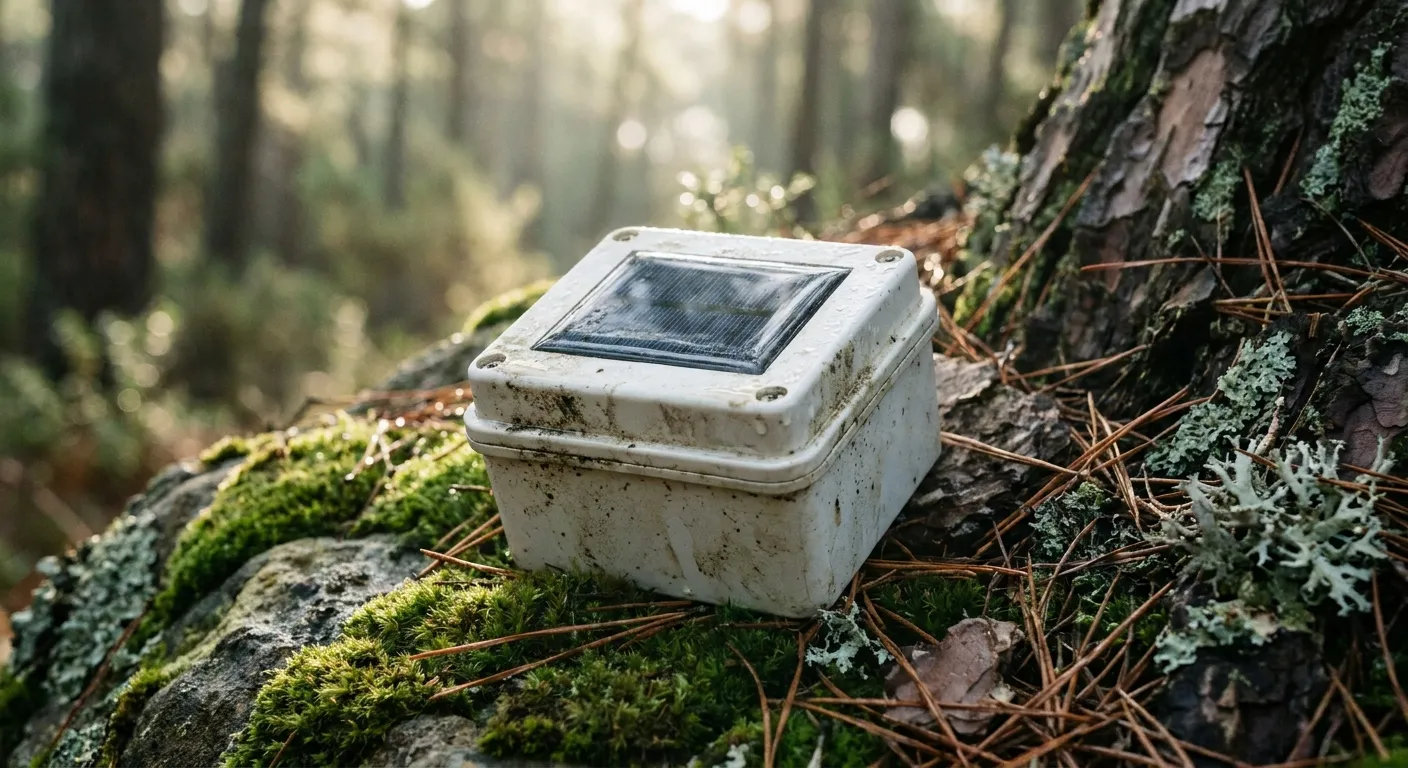
The core
What the network is made of
Air, not images
We measure the air itself: the gas profile of smouldering appears before there is any visible smoke for a camera or a satellite to catch.
Long-range radio
Certified LoRa modules on the 868 MHz band: kilometres of range through the forest, with no mobile coverage and no cabling to lay.
Autonomous solar power
Each node harvests its own power and is built to run for years without a visit. Exact components stay open while the proof of concept runs.
Star topology
Standard LoRaWAN for the pilot. Mesh relaying deeper into the forest is in-house development for a later stage, not for the proof of concept.
From forest air to the crew on duty
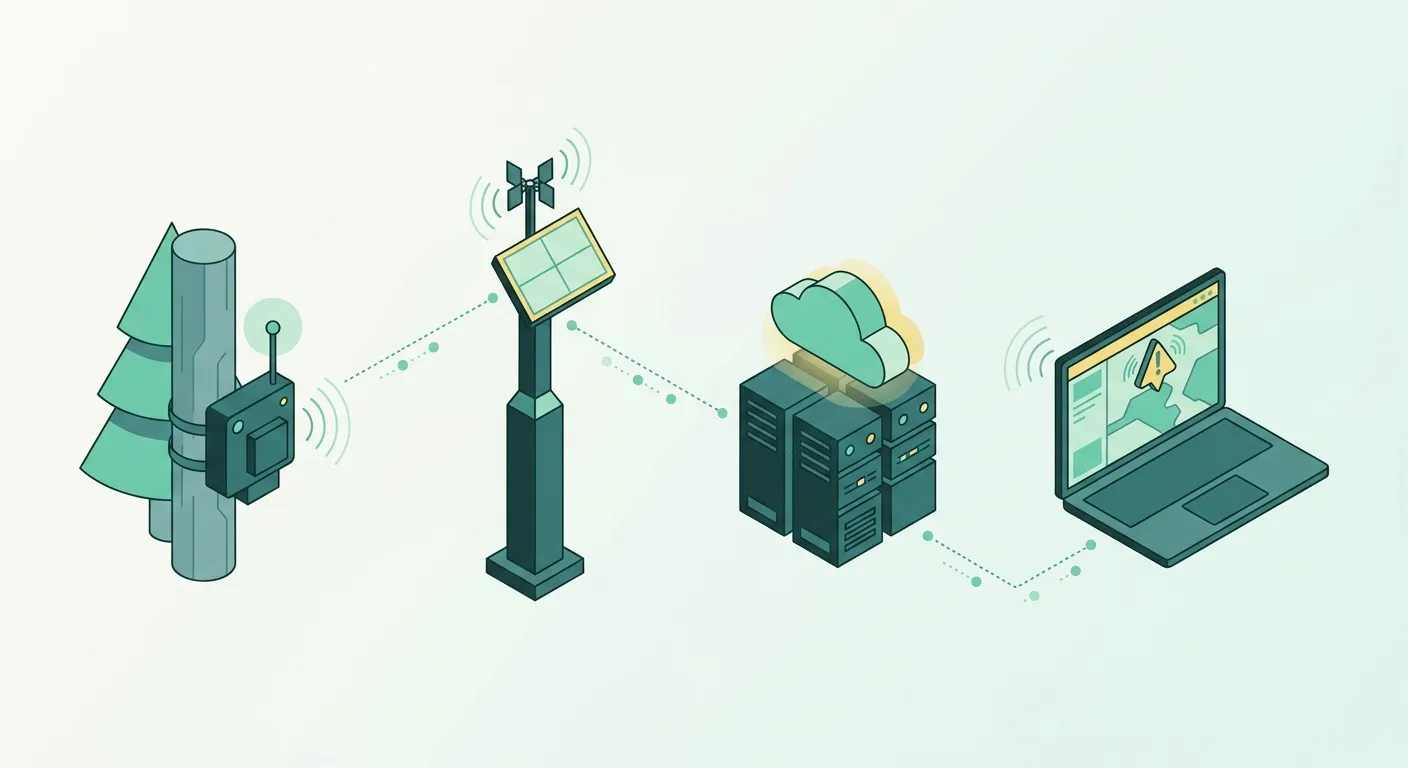
The node smells the air
The node measures the gases released by smouldering, along with temperature, humidity and pressure. Our classifier separates a real fire from the forest's normal background.
LoRa carries the warning
Packets of 20–30 bytes travel kilometres with no mobile coverage. On suspicion, the node increases its reporting rate and flags the alert.
The gateway uplinks it
A solar gateway with LTE or satellite backhaul delivers telemetry to the network server. It is the only point that needs broadband.
The crew gets coordinates
An alert with node coordinates, confidence level and gas trend. The node knows where it stands, so nobody has to guess.
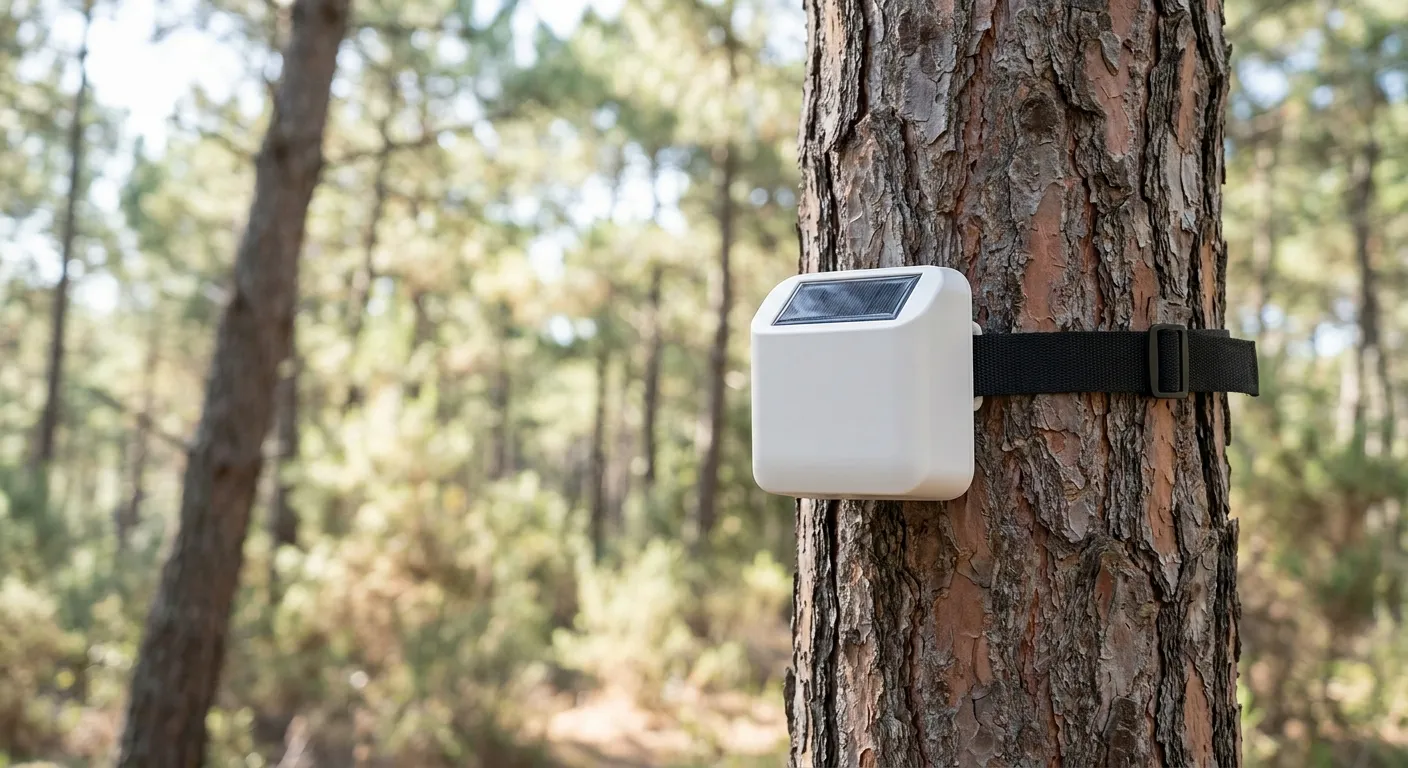
The device
What is inside the node
Note
Components stay open during the proof of concept
We publish how the system works, not a parts list: while phase 1 runs, the hardware can still change. What does not change is the principle: read the air, alert with coordinates, run without cabling.
Coverage
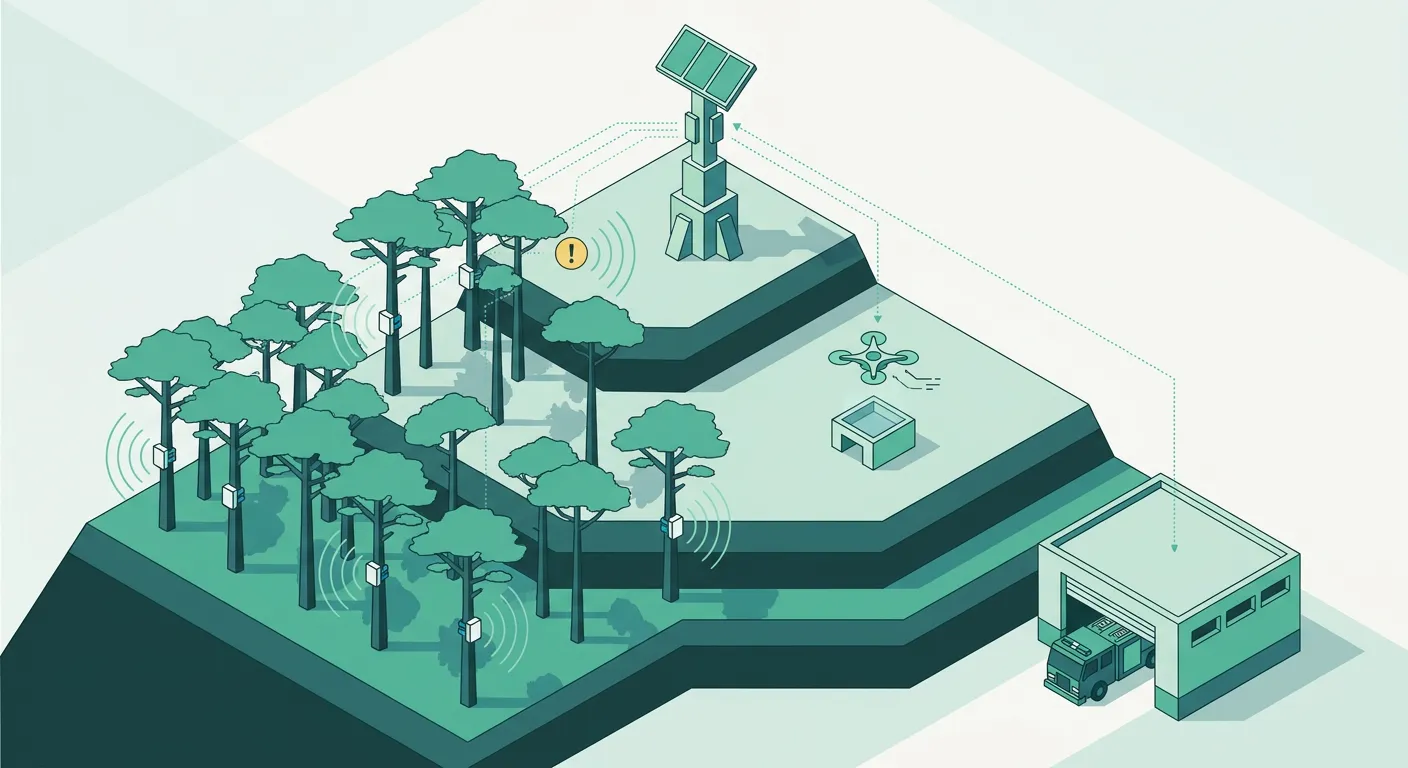
Coverage, planned before a single node goes up
- The whole sector
- Nodes are laid out so the watched area has no blind spots: density follows where the risk actually is.
- No cabling
- Each node powers itself and speaks over long-range radio. Nothing to trench, nothing to connect to the grid.
- Where phones don't work
- Coverage does not depend on mobile signal. Only the gateway needs a link to the outside world.
- Grows section by section
- Start with one slope, extend to the next without rebuilding what already runs.
Monitoring
From detection to the crew on duty
- It watches, you don't
- The network runs unattended around the clock. Nobody has to stare at a screen for it to work.
- An alert, not a data feed
- You get one message: something is burning, here, with this much confidence. Nobody has to interpret a stream of numbers.
- Location included
- The alert carries the position of the node that caught it, so the crew drives to a point, not to a sector.
- Into your existing channels
- Dashboard, email or push, and integration with the emergency services already in place.
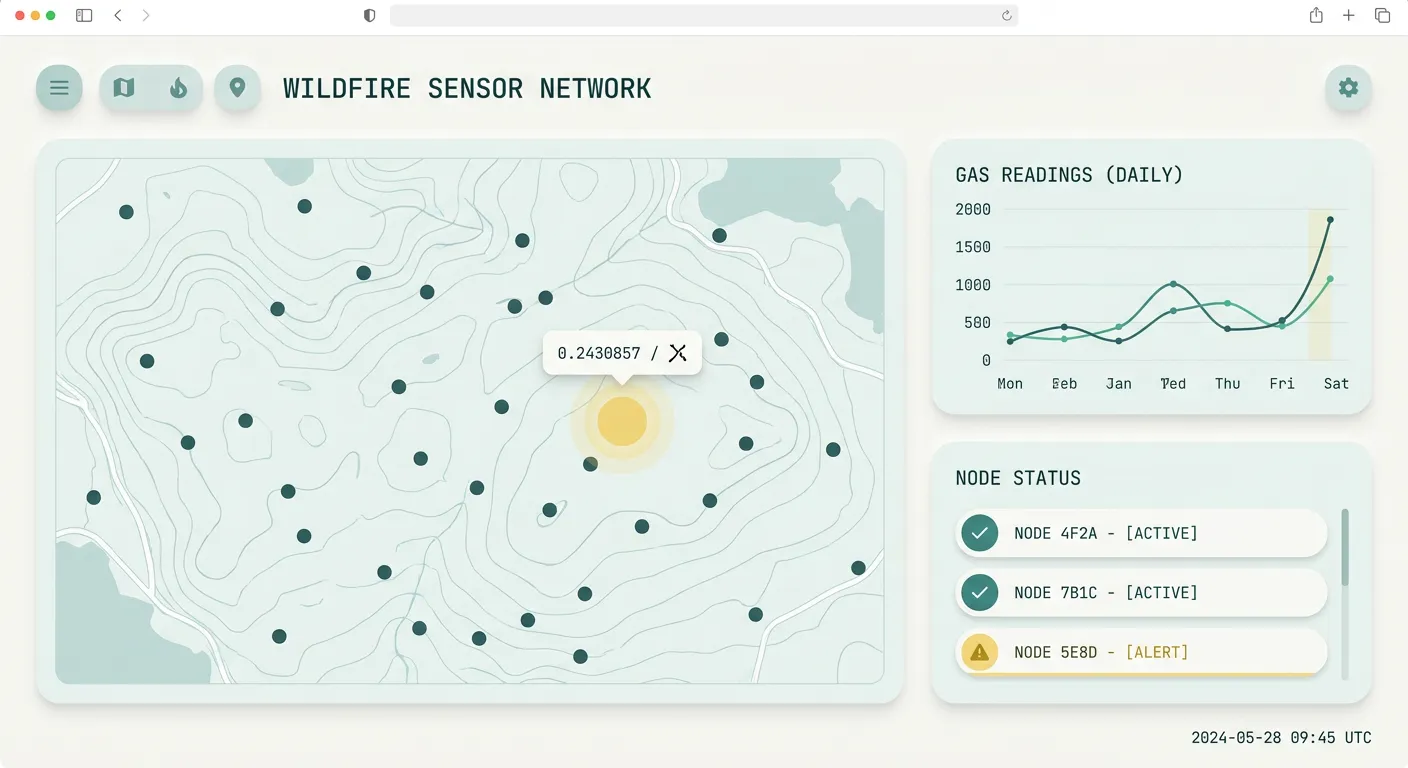
Demo interface · the dashboard is in prototype
The platform
Built on open standards, not on lock-in
Open protocols
The network speaks documented, widely used standards. No proprietary radio and no vendor-only tooling: another supplier could pick the site up tomorrow.
Your data stays yours
Readings, coverage maps and alert history belong to whoever owns the land. Exportable at any time, in formats you can open without us.
Runs unattended
The service that turns readings into alerts is built to work day and night without supervision, and to fail visibly rather than silently.
Fits what you already use
Alerts reach the dashboard, your mail or a push notification, and can be routed into the emergency systems already in operation.
Concrete components, hardware and software alike, stay open while the proof of concept runs. What we commit to is the behaviour: open protocols, exportable data, and an alert that arrives.
Where the intellectual property lives
Not in the hardware: components will keep changing while the proof of concept runs. The asset is the "smouldering vs. forest background" classifier and the accumulated dataset of Mediterranean woodland gas profiles. Every week of watch duty makes it harder to copy.
Honesty
What the test bench does not yet prove
Radio propagation under the forest canopy at 100 m spacing, a network of dozens of nodes, and the real false-alarm background of live woodland. Only the forest pilot proves that, which is exactly why we are asking for one.
Request a pilot